ProMacro_Scope
 ProMacro_Scope Quarterly Bulletin Q1 2026
This quarter’s bulletin delivers exclusive polling, proprietary socioeconomic indicators and in‑depth political and economic analysis. Combined, they offer a uniquely sharp reading of where Greece stands, and where it’s heading.
A few standout insights from this edition:
· Households under pressure despite macro resilience
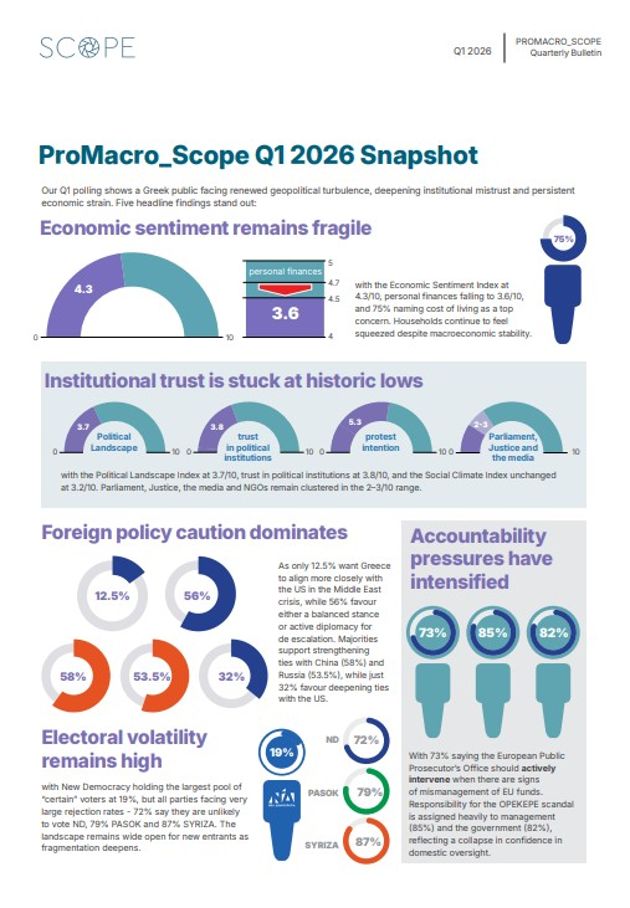
The Economic Sentiment Index inches up to 4.3/10, but personal finances drop to 3.6/10.
75% of Greeks name cost of living as their top concern — a signal that macro stability isn’t translating into lived security.
· Trust in institutions remains at rock bottom levels
The Political Landscape Index holds at 3.7/10, trust in political institutions at 3.8/10, and the Social Climate Index at 3.2/10.
Parliament, Justice, the media and NGOs remain stuck in the 2–3/10 range.
· A public wary of over‑alignment in foreign policy
Only 12.5% want Greece to align more closely with the US in the Middle East crisis.
Majorities favour strengthening ties with China (58%) and Russia (53.5%), while just 32% support deepening ties with the US.
The public's instinct favours balanced diplomacy over hard alignment.
· A cold, fragmented electoral landscape
New Democracy leads the “certain” voter pool at 19%, but rejection rates across all parties remain extremely high:
72% say they are unlikely to vote ND, 79% PASOK, 87% SYRIZA.
The field remains wide open as fragmentation deepens.
· Accountability pressures intensify after OPEKEPE
73% want the European Public Prosecutor’s Office to actively intervene in cases of mismanagement of EU funds.
Responsibility for the scandal is assigned overwhelmingly to management (85%) and the government (82%).
Alongside the data, this edition offers deep dives into:
• Greece’s elevated role in the Middle East crisis
• the political fallout from Predator and OPEKEPE
• the emerging space for new political actors
• the economic implications of the energy shock and revised growth outlook
With elections approaching in late 2026 or early 2027, this quarter’s findings capture a Greece with solid macro foundations but a fragile political and social order, and a government under mounting pressure to regain trust.
 ProMacro_Scope Quarterly Bulletin Q4 2025
Greece enters 2026 with a striking paradox: macro stability on paper, deep social and political strain on the ground.
Our new ProMacro_Scope Q4 bulletin — produced with Prorata — captures this tension with fresh exclusion polling, proprietary socioeconomic indicators and forward‑looking analysis.
This quarter’s signals are unusually clear:
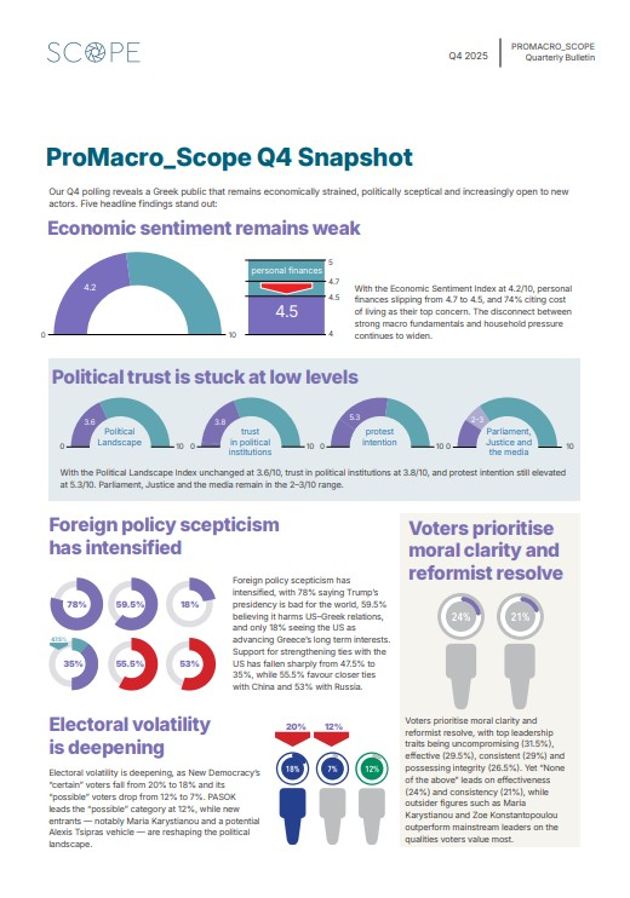
- Economic pressure is intensifying, with the Economic Sentiment Index stuck at 4.2/10 and 74% citing cost of living as their top concern.
- Political trust remains structurally low, with protest intention still elevated.
- Foreign‑policy scepticism has surged, especially toward the US under the Trump presidency.
- Electoral volatility is deepening, as new actors like Maria Karystianou and a potential Tsipras vehicle reshape the landscape.
- Voters are demanding moral clarity and reformist resolve, with outsider figures outperforming mainstream leaders on integrity, consistency and effectiveness.
 ProMacro_Scope Quarterly Bulletin Q3 2025
The ProMacro_Scope Q3 2025 Bulletin captures a Greece grappling with economic strain, political scepticism, and fragile social trust. Polling shows households rate both personal finances and the national economy below neutral, with cost of living, corruption, healthcare, and low wages dominating public concerns.
Citizens strongly favour redistributive measures - health and education spending, tax relief for youth, ENFIA cuts, and VAT reductions - but doubt the state’s ability to deliver, highlighting a “scepticism gap.” Political trust remains weak, with Parliament, justice, and media scoring lowest, fuelling instability and protest risk.
Electoral support is fragmented: New Democracy retains the largest pool of “certain” voters, but a volatile electorate leaves the 2027 race open.
The report also tracks scandals, opposition strategies, and the potential return of Alexis Tsipras. Proprietary indexes underline declining sentiment across economic and social dimensions, painting a picture of a society under pressure and a political system vulnerable to disruption.