-
 Podcast - Has Greece fully recovered from the crisis?
-
 The World Cup, Argentina and Europe’s quest for moral clarity
-
 Greek firms should embrace ESG and DEI despite US-led policy reversal
-
Podcast - Party time: Greek politics in flux ahead of next elections
-
Podcast - Brain Drain or Brain Regain? Understanding Greece’s Talent Flows
-
 How inflation has reshaped Greek household spending
The "King of the North" seeking to heal a fractured kingdom
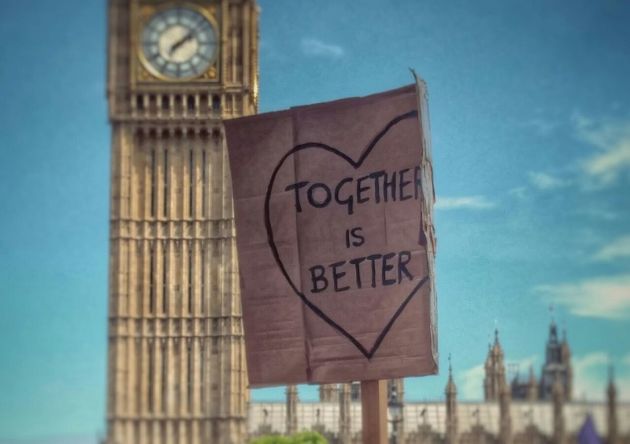
This June marks 10 years since the Brexit referendum - a decade in which the world has been in flux and Britain has been in turmoil. The narrow decision to leave the European Union has shaken the country’s politics, economy and identity.
A decade on, most British voters now view Brexit as a mistake and favour some form of closer relationship with the EU, even if full membership remains a politically sensitive subject that most leaders avoid. In the meantime, the UK economy has struggled, inequality has deepened and British politics has fragmented, allowing Reform UK to rise on the radical right with an ultra‑nativist message that feeds on existing discord and foments further division.
These 10 years have also seen Britain turn inward. The country’s exit from the EU has frayed political, social and cultural ties that once anchored its sense of place in Europe. The result is an island nation that has lost a key point of reference, and whose drift has only accelerated as it searches for purpose, identity and strategy in an increasingly challenging world.
However, this loss of connection has also shaped how the EU now views Britain. Brexit continues to baffle many Europeans, and too often media and political elites on the continent see the UK through a one‑dimensional lens, still clouded by the shock of the 2016 vote and the bitter, messy aftermath that followed.
It appears, though, that Britain has begun to confront questions it avoided for years after Brexit. This reckoning has not come by choice. It has been forced by economic stagnation, geopolitical instability and the galloping opportunism of Nigel Farage and Reform UK. But the questions are finally being asked, and some political figures are beginning to offer answers.
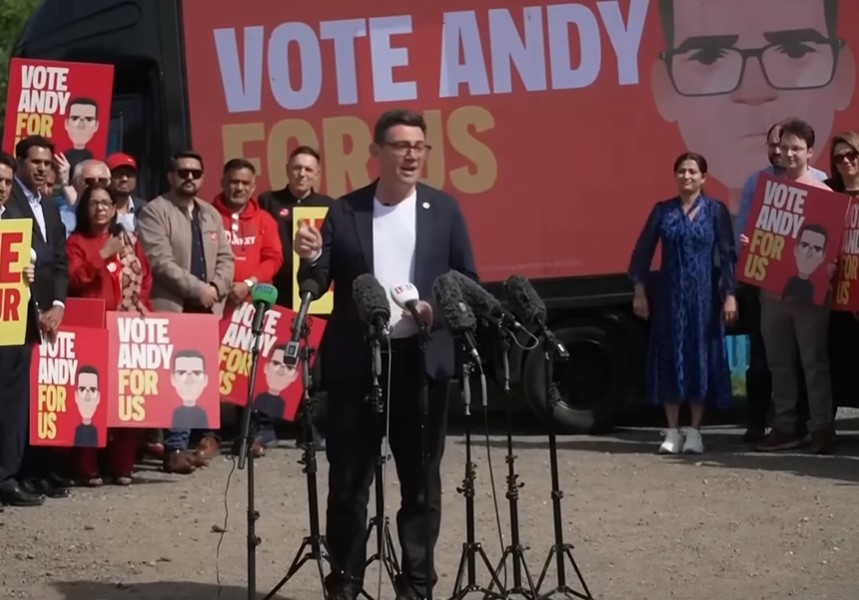
The turbulence inside the Labour Party has become a kind of political laboratory for this moment. Competing diagnoses of Britain’s malaise are being tested, and new ideas are emerging alongside old grievances. At the centre of this ferment is Manchester Mayor Andy Burnham, whose campaign in the Makerfield by‑election is widely seen as the first step toward a challenge for the Labour leadership.
The following analysis traces these developments and uses Burnham’s campaign as a prism through which to understand what is happening in British society and politics. It is an attempt to add depth and dimension to the story of a country still wrestling with the consequences of Brexit, and still searching for a path forward.
========================================
National anthems
The promotional video for Andy Burnham’s by-election campaign in Makerfield, northwest England, opens with two songs by Manchester bands. These UK indie/Britpop anthems sum up the political argument of the Labour Party politician who wants to make the jump from Mayor of Greater Manchester to Prime Minister of Great Britain.
Oasis’s “Some Might Say” evokes a post-industrial landscape of neglect and frustration - the everyday reality of towns, particularly in the north of England, that feel overlooked and left behind. Elbow’s “One Day Like This” offers a cautious optimism that things could change, that renewal is possible after a long period of drift.
Burnham, 56, is using these songs to frame a broader claim about Britain - that the country is stuck between disillusionment and the hope of something better, and that his politics, which is rooted in place, public control and civic renewal, can bridge that divide.
Politics isn’t working for places like ours.
— Andy Burnham (@AndyBurnhamGM) May 18, 2026
I will change that.#AndyBurnham #ForUs pic.twitter.com/N6RsOlVkob
Britain’s current mood of inequality and malaise is rooted in a decade and a half of stagnant living standards and rising insecurity. According to the Office for National Statistics (ONS), real wages in 2024 were still below their 2008 level. During this long period of stagnation, essential costs have surged, compounding the public’s sense of loss. The ONS reports that food prices rose by more than 25% between 2021 and 2023, while the energy price shock pushed household bills to historic highs. The Institute for Fiscal Studies notes that younger generations are facing the steepest decline in home ownership prospects in modern British history. These kinds of pressures have reshaped public attitudes, fuelling grievances and driving many voters to the political extremes.
The June 18 by‑election in Makerfield, roughly 40 km northwest of Manchester, is on the surface a contest for a single parliamentary seat. In reality, though, it has become a proxy for a much larger question: initially, whether Labour can arrest its slide in the polls, reconnect with its fractured electoral coalition, and find a leader capable of confronting the rise of right-wing populist Reform UK, but more broadly about the direction the UK will take in the years ahead.
Burnham is the only Labour figure with broad, cross‑party appeal, and the only one many MPs believe could rebuild the coalition Labour needs to win the next elections. His decision to stand in Makerfield - and the Labour Party’s decision to allow him to do so - has transformed a routine contest into the closest the UK has come to a presidential‑style primary.
Reform won around 50% of the vote across Makerfield’s wards in the UK local elections held this May, compared to Labour’s 23%. Pollsters had given Labour a 5% chance of holding the seat at the next general election. A Burnham victory on June 18 would demonstrate that Labour can still win in the kinds of places it has been losing.
A Reform victory would be a devastating blow. It would serve as a symbolic confirmation that Labour’s problems run deeper than the muddled leadership of Prime Minister Keir Starmer, even though his lack of political instinct and direction have made him a hugely unpopular leader with British voters and much of his party.
Makerfield has the makings of an existential moment for the UK’s social democrats – a last stand against a seemingly relentless onslaught from the far-right opportunism of Reform and its ubiquitous leader Nigel Farage. More than that, though, it feels like a rare chance for the UK to start to heal the bitterness and division unleashed since the Brexit referendum and stop Farage’s brand of far-right politics - fuelled by provocative anti-immigration sentiment, unbridled tech bro capitalism and shameless Trump-style grift – from taking grip of Great Britain and pushing it into an even deeper, darker hole.
Burnham has served for nine years as Manchester Mayor. During that time he has received many plaudits for helping to transform the city, which has high historic, cultural and economic significance. This has earned him the nickname “King of the North”.
Whether he can translate his local success into national achievement remains to be seen. He has many doubters, but by giving up his mayoral post to run in a risky by-election, Burnham has shown that - at least - he recognises the urgency of the moment.
Who is Andy Burnham?
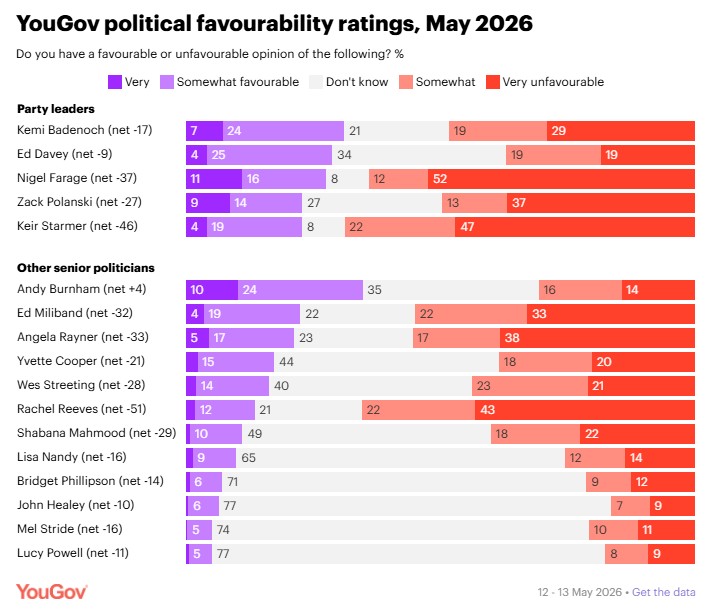
One of Burnham’s strongest cards is that he is the most popular Labour politician in the UK. According to YouGov’s May 2026 favourability tracker, he is the only senior Labour figure with a positive net rating among the public (+4) and the only one viewed positively by a majority of 2024 Labour voters (57%). Even among Liberal Democrat and Green voters, Burnham holds positive net ratings (+24 and +18 respectively).
Part of this appeal derives from his highly visible identity as a northern, working class figure who has remained culturally grounded despite decades in national politics.
Burnham, the son of a telephone engineer and receptionist, has a long‑standing personal connection to Makerfield, having grown up just a short distance from the constituency. He now lives in the wider area with his family. In his campaign video, he speaks about sending his three children to a school in Ashton-in-Makerfield, the town at the heart of the constituency that numbers just over 75,000 voters.
Burnham is a lifelong Everton FC season‑ticket holder, and he is known for mingling with supporters rather than VIPs in corporate boxes. It has reinforced an image of someone who is not only in touch with ordinary voters but comfortable in their company.
His cultural references reinforce this impression. In an interview with the weekly political and cultural magazine The New Statesman last year, Burnham – who studied English at Cambridge University - cited Tony Harrison, the left‑wing Yorkshire poet of the 1980s, as one of his formative influences.
Listening to Harrison as a young man was the first time he realised that English poetry could have a northern voice. Its mournful reflections on the dislocation of working‑class life speak directly to Burnham’s own experience as a boy from the northwest drawn away by the lure of a fuller life elsewhere.
These preferences help explain Burnham’s political tone. He comes across as civic-minded, rooted in place, and attentive to the emotional texture of working class life. They also mark a contrast with Keir Starmer, who has said he neither reads much nor dreams.
The issue of class remains omnipresent in British society and some of Burnham’s critics cast doubt on whether he has genuine working class roots. They argue his upbringing was comfortable enough to categorise him as middle class, and that his studies at Cambridge propelled him into the country’s political elite.
Burnham’s political journey has been long and varied. He served as a special adviser in the Tony Blair government in the 1990s before being first elected as an MP in 2001, then becoming a minister in the cabinet of Blair’s successor, Gordon Brown.
While holding the post of Culture, Media and Sport Secretary (Minister), Burnham experienced one of the watershed moments of his political career. He was heckled while speaking at an event to mark the 20th anniversary of the Hillsborough disaster, when 97 Liverpool football supporters were crushed to death at an FA Cup semi-final game in 1989.
Shaken by his experience, Burnham pushed for the formation of an independent panel to investigate the incident after many years during which the authorities refuted that policing errors caused the fatal crush and denied that these mistakes were then covered up. The panel delivered a report that was critical of the blame that had been placed on fans, and UK law was subsequently changed to ensure public servants face penalties for being untruthful. Burnham admitted that the barracking he received helped him find the “political courage” to take action.
He ran unsuccessfully twice for the Labour leadership - in 2010 and 2015. In both races, his attempts to position himself as a unifying, middle ground candidate struggled to cut through against rivals who captured clearer ideological momentum. Ed Miliband in the first case and Jeremy Corbyn in the second, when a wave of grassroots support led to the election of a leader from the radical left.
Burnham’s record in the centre-left party meant he was often caricatured as a factional chameleon. He rejects this characterisation, arguing that his political identity has crystallised only since returning to Manchester to become its mayor in 2017.
His work in local politics came to national prominence when he clashed publicly with the then British PM Boris Johnson over how the government was handling the Covid pandemic. This moment was instrumental in making him a local hero to many in the northwest of England, and gave rise to the “King of the North” nickname that still accompanies Burnham.
The Mancunian candidate
During his time as Manchester Mayor, Burnham has developed a coherent, although not necessarily complete and iron-clad, critique of the British state. At its core is the argument that the UK is over‑centralised, overly dependent on London, and governed through institutions that are fiscally constrained and administratively brittle.
He contends that decades of policy making from the centre have produced a system that is simultaneously intrusive and ineffective: Whitehall sets targets, controls budgets and dictates priorities, but lacks the local knowledge or institutional capacity to deliver meaningful change on the ground.
The result, in his view, is a state that has lost control of essential services, allowed regional inequalities to widen, and become increasingly vulnerable to external shocks - from bond market turbulence to energy price spikes.
Burnham’s critique is not simply that the state is too small or too large, but that it is configured in the wrong way: centralised where it should be devolved, passive where it should be strategic, and market dependent in areas where public control is necessary for resilience.
He proposes instead a set of governing principles he calls “Manchesterism”. It is his attempt to articulate an alternative model - one that rebalances power between the centre and the regions, rebuilds local capacity, and restores the state’s ability to shape markets rather than be shaped by them.
However, his political strength also lies in something less easily codified. There is a cultural fluency that allows him to speak across divides, to voters who feel ignored by Westminster and to Labour members who want a leader with emotional intelligence as well as administrative competence.
His identity is not incidental to his politics. It is part of the explanation for why he is the only Labour figure who consistently polls well across the party’s fractured coalition.
What is Manchesterism?
The Manchesterism that Burnham speaks of is not a formal doctrine but a set of ideas derived from the experience of governing the city, where his powers are – admittedly - fairly limited and where much of his role is almost pastoral. Manchesterism has four key components: Place-first politics, public control of services, state-enabled investment, and a critique of neoliberalism.
Burnham argues that politics should be organised around place rather than party. In Manchester, this has meant cross‑party collaboration, long‑term planning horizons, and a focus on regional economic ecosystems rather than national political cycles. He contrasts this with Westminster’s short‑termism and factionalism.
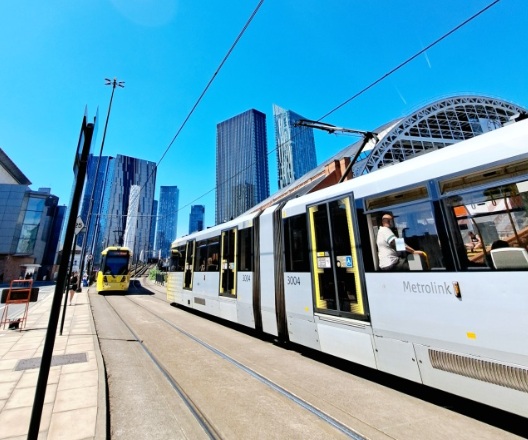
Burnham’s flagship achievement - the Bee Network bus franchising system - exemplifies his approach to public services. Manchester’s buses are not nationalised; they are operated by private companies under public control. The model allows Transport for Greater Manchester to set fares, routes and standards, while using surplus revenue from busy routes to subsidise essential but less profitable services.
Burnham sees this as a template for utilities such as energy and water: not full nationalisation, but stronger public control and regulation.
Manchesterism emphasises the role of local government in shaping markets. Burnham argues that the state must create the conditions for investment through planning, infrastructure, skills and public services while leveraging private capital, including foreign investment. Burnham sees it as “business‑friendly socialism”.
Burnham frequently speaks of “40 years of neoliberalism”. It is a period instigated by the late Conservative leader Margeret Thatcher in the 1980s - deindustrialisation, deregulation, privatisation and austerity – but, by implication, given a continuation by the Tony Blair-led Labour government that was in power between 1997 and 2007. He argues these policies have hollowed out towns like Makerfield. His politics are rooted in a sense of loss: the decline of council‑run leisure centres, affordable housing, and community infrastructure. Manchesterism is an attempt to rebuild these foundations.
Sceptics point out, though, that this approach works well in Greater Manchester partly because the region has strong institutions, stable leadership and a clear sense of identity - advantages many parts of England do not share. What Burnham has achieved in a unified metropolitan area may be much harder to reproduce in places where local councils are weaker, more fragmented, or still struggling with the effects of years of austerity and lack of growth.
Why now?
In the May 2026 local elections, Labour lost ground to Reform and the Greens, who have been reinvigorated by the election of adept communicator Zach Polanski as their leader. Polanski’s brand of “eco populism”, focussing more on hot button issues like the cost of living, Gaza and inequality than the climate crisis has proved particularly popular with left-leaning younger voters.
In the local elections, Labour found itself losing in Leave‑leaning towns and Remain‑leaning cities, in working‑class wards and middle‑class suburbs. As one Labour MP put it: “Labour was losing everywhere all at once.”
This fragmentation reflects deeper trends: Labour and the Conservatives – the powerhouses of British politics for many decades - won just 59% of the total national vote in the 2024 general election. This was their lowest combined share in more than a century. Turnout was the second lowest under universal franchise. The significant parliamentary majority Labour won two years ago rests on support from only one in five British voters.
A More in Common analysis of the 2026 local elections helps explain the deeper forces driving Britain’s political fragmentation. The think-tank’s polling indicates that this fracturing is rooted in a profound sense of unfairness: 61% of Britons believe the social contract is broken and 51% say hard work no longer pays. The cost of living crisis dominates public concern: 71% cite it as the country’s top issue and nearly six in ten think it will “never end”. Meanwhile, 77% of those questioned think things are getting worse in the UK - up a staggering 25 points since the general election less than two yeas ago. Clearly, insurgent parties have a structural advantage in a country where most voters believe nothing ever changes.
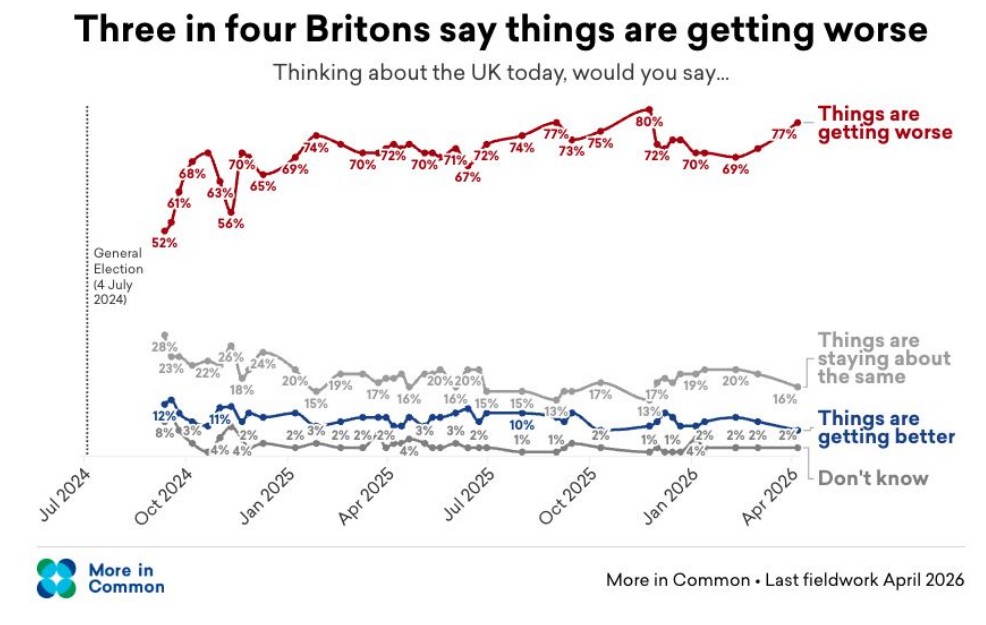
This disillusionment has splintered the electorate. Labour and the Conservatives together won just 36% of the estimated national vote in the 2026 local elections, while five parties now poll above 10%. Young renters drifted to the Greens, financially insecure voters lean toward Labour, and “squeezed middle” homeowners moved to Reform UK. With 54% of councils now under “No Overall Control,” fragmentation has become a common feature of today’s politics in Britain.
The urgency behind Burnham’s candidacy is heightened by the growing perception that Sir Keir Starmer’s government has lost direction. Starmer has been criticised by MPs and commentators for hesitating on key decisions and lacking strategic clarity, creating an impression of drift at the centre of government.
Many activists and MPs frustrated with Starmer’s cautious, highly centralised leadership argue that the party has become too managerial. This has created space for competing factions across the Labour party spectrum to push their own visions of Labour’s future. Figures on the party’s right, such as recently-resigned Health Minister Wes Streeting and those aligned with so-called “Blue Labour” thinking, are increasingly assertive, while others on the “soft left” and traditional left continue to vie for influence over policy, tone, and the party’s long‑term direction.
At the same time, Reform has surged in national polling, establishing itself as a plausible contender in the next general election, due to be held by the summer of 2029.
Burnham is seen by many Labour MPs as the only figure capable of rebuilding a coalition of voters that would make the centre-left party electable again. His appeal cuts across traditional divides: he is popular with Labour members, with Green and Lib Dem voters, and with a significant minority of Conservative and Reform voters. Hypothetical polling by More in Common suggests that replacing Starmer with Burnham would shift Labour from a 7‑point deficit to Reform to a 3‑point lead – an impressive 10‑point swing.
This does not necessarily mean Burnham would win a general election but it does suggest he has a unique ability to reconnect with voters who have drifted away from Labour.
Brexit fault line
Brexit has reemerged as a central issue in the Labour leadership contest. Wes Streeting, Burnham’s likely Labour leadership rival, has said the UK should “one day be back in the European Union” and that Brexit was a “catastrophic mistake”. This position aligns with the overwhelming majority of Labour members.
Burnham, by contrast, has said he is not currently seeking to return to the EU. He acknowledges Brexit has been damaging but argues that “the last thing we should do right now is rerun those arguments”.
Many observers feel that Streeting has raised the issue now to make it more difficult for Burnham to navigate his way to victory in Makerfield, which largely voted in favour of “Leave” in 2016.
Recent opinion polls consistently show that most UK voters believe Brexit has been a failure. According to a recent YouGov poll, 56% of voters want to rejoin the EU, including 79% of Labour voters and 22% of voters who backed Leave 10 years ago. However, pursuing closer relations with the EU, rather than becoming a full member again, is seen as a more desirable option at this stage. It is favoured by 70% of voters.
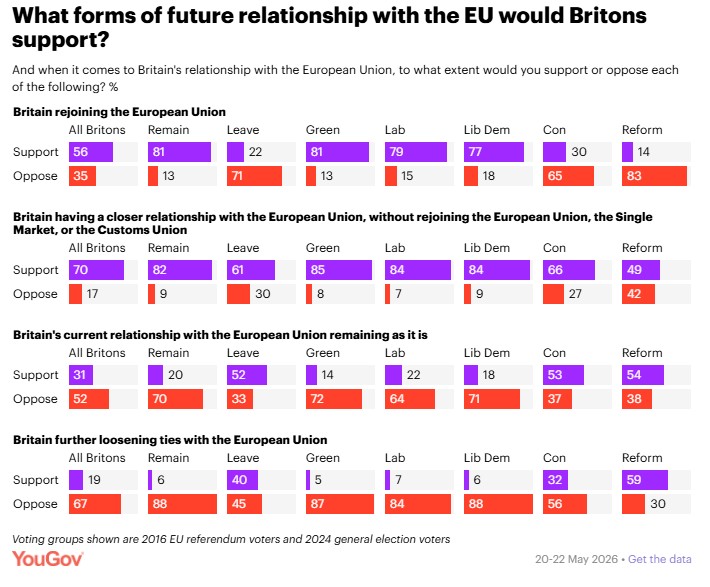
The issue of Brexit, especially anything to do with public admissions that leaving the EU was the wrong decision or that the UK should seek a path back to the Union as soon as possible, remains politically radioactive. Public sentiment has shifted, but the politics have not. For national politicians, reopening the question carries significant risks. In many parts of the country, particularly in deindustrialised areas like Makerfield, Brexit is still bound up with identity, sovereignty and a sense of democratic finality.
Burnham cannot ignore the economic consequences of leaving the EU but he cannot afford to appear to relitigate the 2016 referendum. His stance is shaped by the political geography of Makerfield, where around 65% voted Leave and where Reform is already weaponising his past comments about his hopes that Britain will rejoin the EU “in my lifetime”.
This difficult dance has already threatened to trip Burnham up. In distancing himself from his previous admission of wanting the UK to return to the EU, he has opened himself up to accusations that he is yet again showing a lack of conviction and that he lacks the political clarity to match his personal ambition.
The Brexit question crystallises a broader struggle inside Labour regarding whether the party should lean into the instincts of its pro‑EU membership or rebuild trust in the Leave‑voting towns it has been losing. Streeting and Burnham embody these competing imperatives.
Bond market constraint
However, Burnham’s most controversial recent intervention was his claim that Britain has to “get beyond this thing of being in hock to the bond markets”. He later clarified that he was referring to the state’s loss of control over essential services, not to sovereign debt markets. But the episode highlights a deeper issue around the fiscal constraints facing any incoming UK prime minister.
The UK’s growth performance since 2008 has been dire. According to the Policy Landscape 2025 report by UK in a Changing Europe and the Resolution Foundation, GDP per capita is only 5% higher than in 2008, compared with 40% growth in the previous 15 years. Productivity has stagnated. The IMF warns that the UK has “limited fiscal space”, with debt close to 100% of GDP and borrowing costs rising. Taxes are at historic highs. The government’s fiscal rules leave little room for manoeuvre.
The UK is currently borrowing at some of its highest costs in a generation. Yields on 10‑year gilts - the benchmark for long‑term government borrowing - have risen sharply in recent months, climbing above 4.7%, a level not seen since 1998.
Against this backdrop, even small shifts in political expectations can move markets. When Burnham announced his intention to run in Makerfield - widely interpreted as the first step toward a leadership challenge - gilt yields ticked upward. Markets reacted in part because Burnham is associated with a more interventionist economic approach, including stronger public control of utilities and higher levels of state‑led investment, which investors interpret as carrying greater fiscal risk.
Burnham has now committed to sticking to the UK’s fiscal rules. He has floated ideas such as borrowing outside the rules for defence spending, but these have been walked back. His allies argue that fiscal rules can only be changed “from a position of strength”.
The shadow of the brief and doomed premiership of Liz Truss in 2022 looms large. Any hint of fiscal adventurism risks triggering market instability. Burnham’s challenge is to reconcile his ambitions for public control, infrastructure investment and reindustrialisation with the realities of the bond market.
Structural challenges
The Policy Landscape 2025 report identifies a series of “wicked problems” that will confront anyone wanting to lead the UK government.
Growth is the overriding priority so living standards can rise and public services can be funded. But UK growth is constrained by weak productivity, planning bottlenecks, trade frictions and a weakening labour market.
Also, planning applications are at their lowest since 2015. The government has avoided ambitious planning reform. Housing costs are among the highest in the OECD. Burnham’s ambitions for reindustrialisation and infrastructure will run into these constraints.
Meanwhile, Britain’s public services are crumbling. The 10‑year plan to overhaul the National Health Service (NHS) is underfunded. Social care provisions are under severe strain. Local government faces rising demand and shrinking capacity.
Furthermore, immigration is the public’s top concern (40% in the IPSOS issues index). But reducing migration would harm social care, universities and growth. Burnham must navigate this tension while competing with Reform UK.
On top of this, the government’s refusal to pursue a closer relationship with the EU limits growth potential.
The background to these challenges is low trust in politics, declining support for major parties, and rising populism. This creates a volatile environment.
Turning point?
Andy Burnham appears to offer Labour something it currently lacks: a story about the country, a sense of place, and a record of delivery. Manchesterism is not a fully formed national programme, but it is a coherent response to some of the failures of the British state. But Burnham’s main appeal lies in his ability to speak to voters who feel ignored by Westminster while offering a vision of economic renewal.
However, the constraints are formidable. The UK faces deep structural challenges: low growth, fiscal limits, planning bottlenecks, strained public services, and political fragmentation. If Burnham is elected as an MP and is then able to win the Labour leadership to become Prime Minister, he will have to navigate the Brexit divide, the bond market, and Labour’s internal factions. He will have to square his ambitions with the hard constraints of governing.
Burnham’s political identity is deeply and explicitly northern, shaped by the cultural, economic and social experience of post‑industrial England, which strengthens his resonance in places like Makerfield but may limit his reach in others parts of the UK, particularly in the south.
Also, Burnham’s programme - built around stronger public control of key services, major investment in infrastructure and a shift toward a more balanced economy - is ambitious but still light on detail. He has yet to set out clear costings or explain how these ideas would work within the UK’s tight fiscal limits, or how they could be delivered across regions with very different levels of capacity.
Clearly prompted by Burnham’s run for the job at 10 Downing Street, ex-PM Tony Blair entered the debate on May 26 with an analysis stretching to almost 6,000 words in which he issued a stark warning that Labour is “playing with fire”. He argued that the leadership contest has a “retro 20th‑century feel”, that the party is governing from its “soft‑left comfort zone”, and that neither Burnham nor Streeting is offering the strategic clarity needed in a world undergoing geopolitical and technological upheaval.
Blair’s central charge is that Labour lacks a “worked‑out, coherent plan” and risks being “sliced to the left and right” by insurgent parties. His recipe for Labour to correct its course includes more business-friendly policies, tackling illegal immigration and harnessing the power of Artificial Intelligence.
Even though Blair’s premiership was transformative for the UK in many ways, he is a contentious figure now - a More in Common poll in March found that just 8% of British people questioned think it is “definitely worth” listening to the former PM.
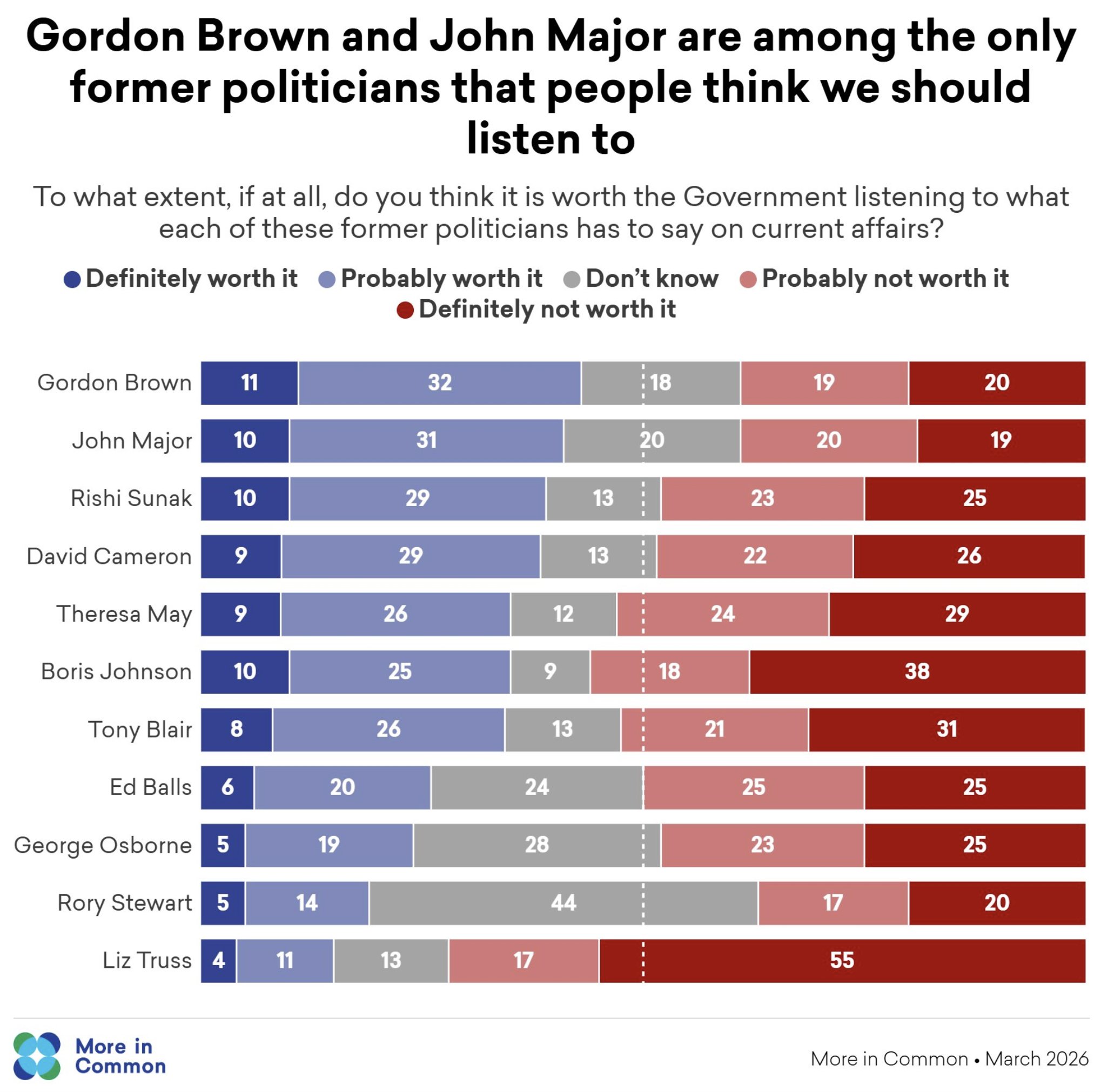
Also, Blair is largely divorced from today’s Labour. His base within the party has withered not just because of the negative legacies of his time in office, including among others the involvement in the Iraq War and the financial liberalisation that preceded the 2008 crash, but also because of his post-premiership activity through the Tony Blair Institute. The TBI’s work has been personally lucrative for the former PM but has led to accusations of being too close to questionable regimes and billionaires.
However, Blair’s Third Way repositioning reshaped the party’s electoral fortunes, delivering Labour’s largest-ever landslide victory and three consecutive ballot box wins for the first time. This means that his opinion on party politics carries some weight. Also, his argument that Labour and the UK need a contest of ideas rather than personalities does resonate at a time when the party is searching for direction and identity, much like the country.
Burnham, though, argues that those ideas have to be built on an understanding of what has gone wrong in Britain and an acceptance that governing from the “radical centre”, as Blair advocates - and as happened during his time in office - have contributed to the current high levels of voter discontent and distrust.
“If you don't get how that's driving politics now, if you are not rooting your analysis in the fact that people are unable to live and that things that were taken for granted are no longer affordable, then you are not understanding what's going on,” Burnham said in response to Blair’s missive, while highlighting the absence of the word “inequality” from the ex-PM’s analysis.
“People don’t think the centre has delivered for them in terms of their lives, therefore they've gone further to the extremes,” he explained in comments to The Observer, adding that one of the problems of “Blairism” was that it “saw the market as always the answer.”
Burnham followed this up with his own written intervention. In an op-ed in The Times, Burnham focused on what he called the “gaping omission” in Blair’s analysis: the failure to acknowledge that life for millions of Britons has become materially harder since the 2008 financial crash. Falling living standards, he argued, are the single biggest driver of political turmoil and the collapse of support for traditional parties. He rejected Blair’s call for deregulation, pointing to the 2008 crash as evidence that “a failure of regulation” cannot be solved by more of the same, and defended Greater Manchester’s “very interventionist” model as proof that growth requires strong public control, not market laissez‑faire.
The two other key figures at the centre of Labour’s internal debate, PM Keir Starmer and former minister Wes Streeting, also published written responses to Blair’s analysis.
Streeting, who grew up in a single-parent working class family in East London, accused Blair of treating inequality as “peripheral rather than fundamental”. Inequality, Streeting argued, is the root cause of the democratic fractures reshaping Western politics, fuelling resentment when people believe the economic rules “no longer reward effort fairly”. He pushed back against Blair’s insistence that Labour must prioritise market confidence, arguing instead that markets must “serve society rather than dominate it”, and warned against Blair’s call for closer alignment with the United States, invoking Iraq to argue that “Atlanticism cannot mean automatic subservience”.
Starmer mounted a more defensive response, in keeping with his more subdued style. He insisted that the decisions made since Labour’s election victory in 2024 were “the right policy choices” for the situation the party inherited. He rejected Blair’s claim that the government lacked a coherent plan. In a 3,000‑word essay, he argued that stabilising the economy, spreading wealth creation and improving public services were already delivering results, even if the government’s early “mood music” had been too negative. Starmer’s rejected the idea that Blair’s 1997 playbook, he suggested, cannot simply be reapplied to a country facing a very different set of challenges.
The striking feature in this exchange between the four men is not that there is disagreement within a governing party that has a comfortable parliamentary majority (it currently holds 403 of 650 seats), but the fact that this debate is happening openly and at an intellectual depth that has been absent from British politics in recent years.
After a decade in which the UK has drifted - economically stagnant, socially divided and unsure of its place in the world - Labour is finally beginning to interrogate the deeper political, social and existential questions it avoided after Brexit.

The exchange between Blair, Burnham, Streeting and Starmer marks the first serious attempt in years to articulate competing visions of Labour’s purpose, its economic philosophy and its role in a country that has lost its sense of direction. For a Britain still wrestling with the consequences of Brexit, the multiple crises that have followed and a decade of national introspection, this seems to be a welcome development. A political system that has spent years managing crises rather than debating ideas is, at last, being forced to ask what it stands for, and what kind of country it wants to build.
The Makerfield by-election will reveal whether Burnham’s politics of place, authenticity and public control can withstand the pressures of national politics. On a larger scale, this vote will show whether Labour has a route back to the voters it has been losing and can reconnect with the places that once formed its backbone. On a macro scale, though, the result in Makerfield could prove decisive in the process of the UK converging around a common political identity and direction after many years of seeming to roam aimlessly.
A Burnham defeat could suggest that Labour’s political coalition is fracturing faster than it can be rebuilt and that the forces pulling British politics apart - populism, fragmentation, distrust - are now stronger than anything the current governing party can offer in response. A victory for the Manchester Mayor could spark an even deeper and more meaningful debate about where Labour, the current government and, more broadly, the country goes from here.
“Throw those curtains wide,” sing Elbow in the song used in Burnham’s campaign video. “Some might say we will find a brighter day,” is the incantation in the Oasis track chosen by the Labour politician. Whatever the outcome, the Makerfield by‑election has already forced Labour, and the country, to think about what kind of politics can rebuild trust and deliver renewal after years of division, confusion and decline. The questions confronting British politicians, and the electorate, are brief, but complex and compelling: Who are we? Where do we want to go? What is the best way of getting there?