-
 Podccast - The Great Sea Interconnector and its high-voltage politics
-
Podcast - Economic gain, social strain and political pain: Greece’s road to elections
-
 The making and unmaking of "Greek statistics"
-
 Magdeburg shocks Berlin
-
Podcast - Has Greece fully recovered from the crisis?
-
 The World Cup, Argentina and Europe’s quest for moral clarity
A summer tan can’t obscure Greek economic reality
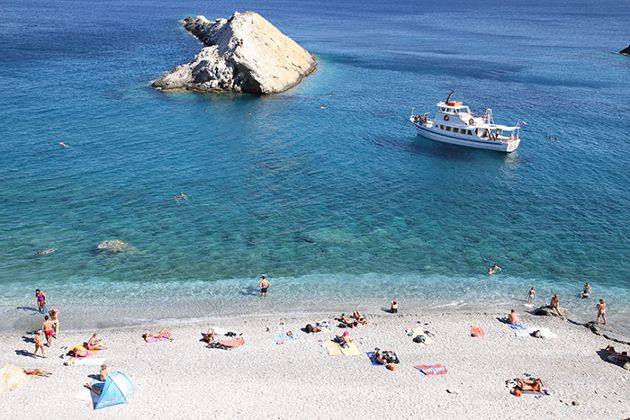
“We are not in an economic disaster — everyone came back with a tan,” was the comment made by a prominent government minister on a morning TV show just a week ago, when he was asked about the pressures households are facing from the cost of living.
The argument largely reflects the frustration among officials and ministers that the government has not managed to gain significant credit, in the eyes of the public, for the economic progress achieved since it came to power in 2019.
The response itself is weak, amounting to an attempt at deflection, since nobody is claiming that Greece is currently experiencing an economic disaster. Greeks have lived through an economic disaster not long ago and can recognise one. Using an exotic tan as an indicator of prosperity can only be interpreted as parody.
To be fair, Prime Minister Kyriakos Mitsotakis has every reason to feel irate, as the cost‑of‑living crises that have hit his government are both external. One began with the war in Ukraine, and just as conditions appeared to be stabilising towards the end of 2025, the United States launched a miscalculated war in Iran that was expected to last only a couple of weeks. Six months on, its main global impact — the closure of the Strait of Hormuz — is still causing widespread disruption.
Polycrisis
The story was meant to have played out differently. The RRF was supposed to boost investment and economic growth in the post‑COVID era; the fiscal picture would have remained compliant, meeting agreed targets; further credit‑rating upgrades would have been secured; Greece would finally have reached investment grade for the first time since the crisis; rapid debt reduction after the pandemic peak would have reinforced the narrative — all culminating in the construction of a profile of a competent and responsible government.
This is exactly where the source of frustration can be found, because everything else unfolded exactly as it was supposed to. Yet the Greek public feels that the economy is one of the weakest areas of the current government, and by a wide margin considers the economy and the cost of living to be its main sources of concern.
It is odd, to say the least, that the Greek government has largely opted to disparage anyone who suggests that spending power has come under pressure during its tenure. If this is not the official line, it is certainly the line adopted by some of its officials with a prominent, frequent or loud presence in the media.
The main purpose of economic growth is to improve people’s standard of living and to boost their economic prospects. Fiscal responsibility — although in Greece’s case it is bound by agreements with European lenders — is intended to ensure that a repeat of the 2009 crisis never happens again.
Both are also a form of safety policy for international markets, and on both fronts Greece has secured a vote of confidence. This is evident in the recent bond transactions undertaken amid the Iran war, all of which were crowned with complete success, attracting significant demand and delivering highly competitive borrowing costs.
However, this is not the conversation at hand. Two major inflation waves — a persistent one triggered by the war in Ukraine, and a sharp surge in the first months of the Iran conflict — have made life in Greece increasingly unaffordable. The vast majority of Greeks are now poorer in spending terms than they were in 2022.
Miserable data
The picture is rather grim when one compiles the data from the household budget survey and the price increases across the same categories since January 2022.
The household budget survey shows that, on aggregate, Greeks allocate roughly 21% of their spending to food, followed by housing at 14.4%, transport at 13.3%, restaurants and hotels at close to 12%, and health at roughly 8%, completing the top five spending items. Clothing is close behind, accounting for around 5% of expenditure.
These categories have surged since the start of 2022: food prices are up 28%, housing 10%, transport 17%, restaurants 35.5% and health 14%. Clothing has risen by 64%.
When all spending categories in the budget survey are weighed against the respective price rises over the last four years, the loss of spending power due to inflation comes to 20.4%. Unless someone’s wages have risen by 20.4% over the same period, they are worse off than they were four years ago.
The picture is even grimmer for low‑income households, as they allocate a significantly larger share of their income to these basic needs, and the price hikes have affected them even more. Incomes over this period have not kept pace with these price developments.
The minimum wage rose from 713 euros per month in 2022 to 920 by 2026. While this represents a notable nominal increase of 29% for the lowest‑paid workers, it has been stretched thin by disproportionate spikes in basic survival costs such as food and housing.
The spending‑power squeeze has also reached the middle class, as even their incomes have struggled to keep up with the cost of living, leading many to dip into their savings. Greece has had a negative saving rate for years, and household deposits are not being turned into savings.
In 2024, more than 40% of Greeks were in arrears on mortgage, rent or utility bills. Around 60% of the disposable income of low‑income households is now allocated to housing. Among households below the poverty line, 80% cannot keep up with housing‑related expenses.
The findings of surveys are equally damning, no matter how much government officials try to portray Greeks as misery‑guts.
More than half of Greeks cannot afford a week of vacation, and of the 44% who intend to travel, half will stay in a family home. Only 7% of respondents in a recent survey said their economic situation had improved since last year, while 47% said it had deteriorated.
Policy challenges
The government’s positive economic narrative crashes against these realities on the ground, making public debate awkward for officials, as the situation demands specific policy responses. Several initiatives and handouts have indeed been introduced, along with efforts to reduce prices and targeted subsidies, but they have had only a moderate impact on the public’s perception that their household finances are under serious strain.
The government vehemently rejects any VAT reductions, even for basic goods, because one positive side‑effect of the cost‑of‑living crisis and the price hikes is that VAT intakes have consistently exceeded initial estimates. This has allowed the government to use the additional fiscal space for tax relief measures and handouts that, in theory, should improve its standing with the public.
With close to 70% of people in opinion polls saying that the economy is heading in the wrong direction, this approach does not appear to be having the desired effect. Support for New Democracy is also stuck in the 26–28% range, despite repeated attempts to woo the public with handouts.
Despite these frustrations within government ranks, it is puzzling why prominent ministers and officials feel compelled to challenge the public when it voices its struggles — especially when it is universally accepted that global inflation has eroded living standards and that the weakest in society have felt the impact most acutely.
The recent crises have hit the Greek economy just as it was edging upwards, having already lost about a quarter of its GDP in under a decade. Incomes fell by roughly the same proportion.
Having endured the largest economic crisis faced by a developed economy since the Great Depression, the period from 2019 to 2026 was meant to be Greece’s time to mend. Instead, it became one crisis after another, beginning with COVID.
The real incomes of Greeks have barely moved, their living standards have not improved, and their spending power is now comparable to Bulgaria — at the bottom of the EU table.
A tan will not take you far once the first autumn rains arrive.
1 Comment(s)
-
Posted by:
I know of no other country where the gap between macroeconomic success and microeconomic reality is as wide as in Greece. There can be no question that Greece's macroeconomic development since the crisis has been a "miracle". At the same time, this article points out the very unsatisfactory situation on the micro level. Trickle-down is not working. And the government is unnecessarily stingy. While revenues are trending above budget, expenses are consistently below budget (mostly by cutting planned investments short). Sometimes it seems to me that the government's first priority is to get AAA-grades for budget performance, regardless at what cost to the people. The Prime Minister should understand that being the poster-boy for the international audience is one thing but elections are decided by how the domestic audience experiences day-to-day life.